
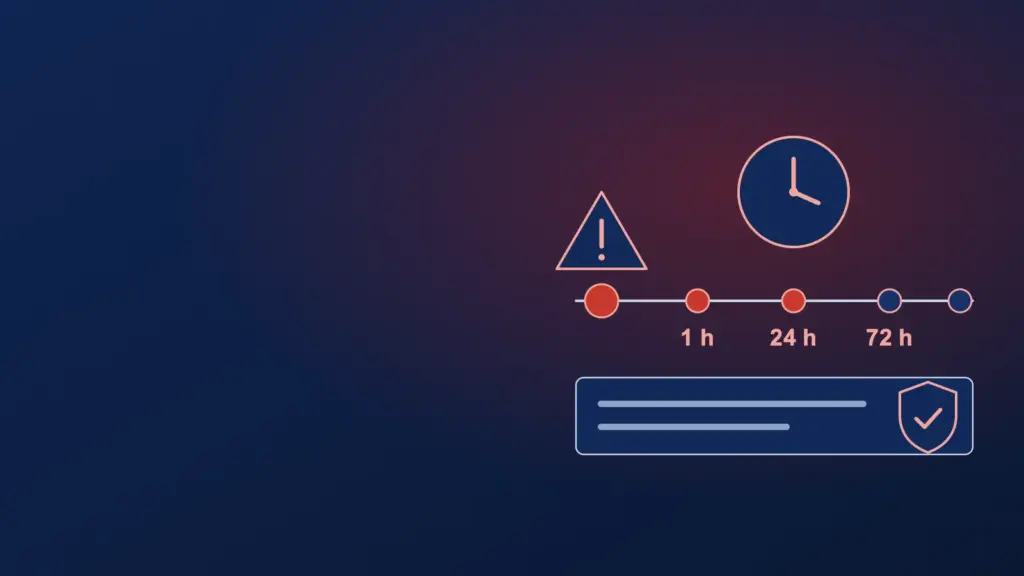
A hospital cyberattack is decided in its first hours. The team has to confirm the event, cut off the infected parts of the network, move the wards to downtime procedures and preserve evidence before anyone starts repairing anything. The reporting clocks run at the same time: in Poland, 24 and 72 hours to the health-sector CSIRT and 72 hours to the data protection authority. This article follows such an event hour by hour and shows what you can prepare in advance.
Polish hospitals have been hit by ransomware in recent years, and a hospital cyberattack differs from an attack on a company in one way: you cannot lock the doors and send people home. Patients are on the wards and the emergency department keeps working. The scenario below is a model built from typical elements of such events, not an account of any particular facility. The response steps apply in any country; the reporting rules are those of Poland, plus the GDPR deadline that applies across the EU. Legal status as of November 2026. This article is for information only and is not legal advice. If an incident is under way and you need a team to preserve evidence and establish the cause, see our incident forensics service.
How a hospital cyberattack starts before anyone notices
An attack usually starts hours or days before anyone sees it, with a stolen password or an exposed service; the ransom note on the screens is the last stage, not the first. According to CSIRT CeZ data presented on 1 October 2026, the most frequent incidents in Polish healthcare in 2025 were computer fraud including phishing (580 cases), vulnerable services (344) and credential leaks (148). CSIRT CeZ is the sectoral CSIRT for health, run by Centrum e-Zdrowia (the e-Health Centre, CeZ). Those three categories are also the three typical routes into a provider’s network. The e-Health Centre also reported (in Polish) that the team had handled 1,379 incidents in the sector by the end of September 2026.
A typical attack has four stages:
- Entry. A password obtained with a fake message, an unpatched remote access service, or a vendor’s service account without multi-factor authentication.
- Reconnaissance and privilege escalation. The attacker looks for the domain controller, the hospital information system servers and the backup repository. This stage can take from a few hours to many days.
- Data exfiltration. Databases and documents are copied out so that the attacker can later threaten to publish them.
- The strike. Backups are destroyed or encrypted first, then servers and workstations. Attackers like to pick a night or a weekend, when the fewest people are on duty.
Two practical conclusions follow. First, an attack can be stopped at stage two or three if someone is watching the logs around the clock; that is the job of a 24/7 SOC. Second, once encryption has started, the attacker knows the network better than the IT engineer on call, and decisions have to be made with incomplete information. That is why the order of actions should be agreed beforehand.
Hospital cyberattack hour by hour: the timeline
The table shows a model response in a hospital with an admissions unit or an emergency department, counted from the moment of detection. In real life the stages overlap, but the order of priorities stays the same: patients, isolation, evidence, notifications, recovery.
| Time since detection | Situation | Technical team | Management and wards |
|---|---|---|---|
| 0:00–0:15 | Workstations at registration and on the wards cannot open patient records. The file server shows files with a changed extension and a ransom note. | The on-call IT engineer confirms this is not an ordinary outage, records the time of detection and photographs the screen with the note. | The coordinating nurse calls the IT emergency number. Nobody restarts a computer. |
| 0:15–1:00 | Encryption may still be running on other machines. | Cuts off network segments, remote access and the backup repository. Informs the head of IT and the incident contact person (in Poland, the one designated under the KSC Act). | The director or the person deputising convenes the crisis team. Wards switch to paper procedures. |
| 1:00–4:00 | The initial scope is known: which servers and sites are affected. | Secures logs and disk images, lists the encrypted systems, contacts the hospital information system vendor and the forensics team, checks the state of the backups. | Decision on planned procedures and admissions for the next 24 hours. First message to staff. Spare phones and the paper contact list come into use. |
| 4:00–12:00 | The situation is contained, but the entry route is still unknown. | Sends the early warning to the CSIRT (CSIRT CeZ in Poland) with a request for guidance. Changes privileged account passwords from a clean workstation. Looks for traces of data exfiltration. | The data protection officer starts assessing the breach. A notice for patients goes on the website and at registration. The hospital’s owner or founding body and its partners are informed as the plan provides. |
| 12:00–24:00 | The first shift is tired, and pressure grows to “switch everything back on” quickly. | Draws up the recovery plan with the order of systems. Builds a clean environment. Hands over to a fresh team after a dozen or so hours of work. | Situation report every few hours. Cover rota. A check that the early warning went out before the 24 hours ran out. |
| 24–72 hours | The first critical systems return in an isolated segment. | Restores from backups verified as clean, keeps monitoring heightened, supplies further information to the CSIRT. | Serious-incident notification before 72 hours have passed. Breach notification to the data protection authority (UODO in Poland) if the assessment confirmed a breach. Second notice for patients. |
| Days 4–14 | Systems return gradually, ward by ward. | Restores workstations, changes all user passwords, closes the entry route. | Paper records from the outage are put in order. Data subjects are informed without undue delay as soon as the assessment shows a high risk; this does not wait for the end of recovery. |
| Within one month of the notification | Work is back to normal, but backlogs remain. | Forensic report and a list of changes to security. | Final report to the CSIRT, or a progress report. Post-incident review and plan update. |
The 24-hour, 72-hour and one-month deadlines come from Polish law and GDPR and are explained below. If you operate in another country, put your national reporting deadlines in their place. The rest of the sequence does not change.
Who leads the response? The crisis team
The response is led by a crisis team chaired by the hospital director or a designated deputy, not by the IT department. IT is responsible for the technology, but decisions about admissions, procedures, public statements and spending belong to management.
In Poland this is also a matter of law. The rules sit in the National Cybersecurity System Act (the KSC Act), which transposes NIS2 and was amended by the Act of 23 January 2026 (Journal of Laws 2026, item 252), in force since 3 April 2026. Under Article 8c of the amended KSC Act (in Polish), the head of an essential or important entity is responsible for meeting its cybersecurity obligations even after entrusting them to another person. The head of the entity is the managing director or management board of a company, or the director of a public hospital. More on this in our article on NIS2 management liability in Poland.
| Role | Usually filled by | Responsible for | First decision |
|---|---|---|---|
| Team lead | director or designated deputy | priorities, resources, approval to shut systems down | declaring downtime mode |
| Medical coordinator | medical director, chief nurse | patient safety, running the wards without systems, staffing | which planned services to postpone |
| Technical coordinator | head of IT | isolation, recovery, contact with vendors | what to cut off first |
| Security and reporting | person responsible for information security, incident contact person | incident record, classification, notifications to the CSIRT (CSIRT CeZ in Poland) | recording the moment of detection |
| Data protection | data protection officer | breach assessment, notification to the data protection authority, informing patients | which data may have been affected |
| Communications | spokesperson or designated person | messages for staff, patients and the media | one channel and one version of the facts |
| Legal | legal counsel | contracts with vendors, reporting to law enforcement, correspondence with authorities | who signs outgoing letters |
| Logistics | administrative director | forms, phones, runners, emergency purchases, facilities for the team | releasing the stock of paper forms |
| Log keeper | designated administrative employee | decision log with times and names | opening the log |
Three rules save the most trouble. Every role has a deputy, because a crisis lasts days, not hours. The team meets at fixed times and ends each meeting with a list of tasks with names against them. The on-call IT engineer has authority, granted in advance, to cut off the network without waiting for the director’s approval, because at night a fifteen-minute delay means more encrypted servers.
What to do in the first hour of an attack
In the first hour you do four things, in this order: confirm the event and record the time, isolate the infected parts of the network, move the wards to downtime procedures and convene the crisis team. Repairing anything is not on that list.
Isolation: what to cut off and in what order
- The backup repository. Disconnect it from the network and pause the backup jobs so that good copies are not overwritten with encrypted data. If a backup survives, the hospital has something to recover from.
- Remote access. Switch off the VPN, remote desktops and vendors’ service channels. The attacker is often still in the network, watching the response.
- Network segments. Break the connections between sites and segments at the core switches or the firewall. Individual workstations are unplugged from the cable and taken off the wireless network.
- Compromised accounts. Block the accounts the attacker used. Change privileged account passwords only from a machine you are sure is clean.
- Connections with partners. Suspend integrations with external laboratories, other facilities and service providers, and warn them by phone so that the attack does not travel further.
What not to switch off and what not to touch
Isolation means cutting a machine off from the network, not from the power supply. A machine that is powered off loses the contents of its memory, which can hold traces needed to reconstruct the attack. There is one exception: if encryption is still running and the machine cannot quickly be cut off from the network and from its disks, powering it off can be the lesser evil. Write that decision in the log, with the time.
Medical equipment is a separate category. Life-support and patient-monitoring devices are not switched off because of an IT incident. You isolate the network segment they work in, and staff operate them locally, at the device. Our article on medical device cybersecurity in hospital networks describes how to prepare the network for this.
In the first hour you should also not:
- restart servers or run “cleaning” tools on them;
- log in to infected workstations with a domain administrator account, because that hands the attacker another set of credentials;
- plug private laptops or USB drives into the network “just for a moment”;
- reply to the attackers or open the websites they point to from hospital computers.
How to keep patient care going when systems are down
Care continues thanks to downtime procedures prepared before the attack: paper order and observation charts, handwritten identification wristbands, urgent test results passed on by phone, and runners between the wards and the laboratory.
In Poland, the medical records regulation (in Polish), that is the Regulation of the Minister of Health of 6 April 2020 (consolidated text Journal of Laws 2026, item 1391), allows records to be kept on paper where organisational and technical conditions make it impossible to keep them electronically (§ 1(2)). The same section adds in § 1(3) that a document kept in one form may not be kept in the other at the same time. The procedure therefore has to say in advance what happens to the paper records once the systems are back. In other countries, check the national rules on medical records before you rely on paper forms.
For the crisis team, three medical decisions matter in the first 24 hours: which planned procedures and admissions to postpone, how to organise urgent admissions without access to patients’ medical history, and when to ask neighbouring facilities for help. The medical coordinator makes them under the hospital’s own procedures. The technical team supplies a realistic forecast and makes no promises of the “it will be working in two hours” kind. How the wards work, how long each process can stay down and in what order systems come back are covered in the article on keeping admissions open during hospital ransomware.
How to preserve evidence after an attack
Evidence is preserved before recovery starts: logs are copied out of the infected network, disk images are taken of the most important machines, and a log of actions is kept. Without this you cannot establish how the attacker got in, and a restored system may then be encrypted again.
- An event log kept from the first minute: who noticed, decided and did what, and at what time.
- The ransom note, photographs of screens and a few sample encrypted files.
- Logs from the firewall, the VPN, the domain controller, email, endpoint protection and the hospital information system. Copy them before log rotation overwrites them.
- Disk and memory images of at least the first infected workstation, the domain controller and the server from which encryption was launched.
- The original media. Systems are restored onto new or spare disks, and the encrypted ones are set aside and labelled.
- A chain-of-custody record: who handed which medium or copy to whom, and when, with checksums of the files.
Several parties will need this material. In Poland, the final report to CSIRT CeZ has to state the type of threat or the cause that probably triggered the incident (Article 12a of the KSC Act). An essential or important entity also gives the competent CSIRT access to information on the incidents it records and cooperates with it while the incident is handled (Article 11(1)(2) and (5)). The data protection officer needs the material to assess which data were affected, and law enforcement needs it for the investigation. Preserving evidence while rescuing systems is usually more than an IT department of a few people can manage, so it is better to sign a contract with an external team before the incident.
Who has to be notified, and when?
In Poland, a hospital that is an essential or important entity notifies CSIRT CeZ of a serious incident (an early warning within 24 hours and an incident notification within 72 hours of detection) and, if personal data were breached, also notifies the Polish data protection authority (UODO) within 72 hours. These are two separate duties, and one event can trigger both. The breach notification comes from GDPR, which applies across the EU; the CSIRT deadlines come from the KSC Act.
A serious incident under the KSC Act is one that causes or may cause serious degradation or interruption of the service, financial losses, or serious material or non-material damage to others. The thresholds for classifying an incident as serious are set in implementing regulations, so check the current rules on the CSIRT CeZ pages.
| Recipient | When | Who prepares it |
|---|---|---|
| CSIRT CeZ | early warning within 24 hours and incident notification within 72 hours of detection; final report within one month of the notification (Article 11(1)(4)–(4c) of the KSC Act) | contact person |
| Data protection authority (UODO in Poland) | within 72 hours where a personal data breach has occurred (Article 33 GDPR) | data protection officer with the controller |
| Data subjects | where the risk to them is high (Article 34 GDPR) | data protection officer, communications |
| Users of the service, that is patients | where a serious incident adversely affects the provision of services (Article 11(2b) of the KSC Act) | communications |
| Law enforcement | where the incident bears the hallmarks of a criminal offence; the sectoral CSIRT provides information on how to report it (Article 12(2)) | legal counsel |
| Vendors and partners connected to the hospital’s network | immediately, so that they cut the connections on their side | technical coordinator |
The early warning is short and may include a request for guidance or technical support, to which the sectoral CSIRT replies within 24 hours at the latest. It pays to send it in the first few hours, not in the twenty-third. The reporting channels, the content of each document and the relationship between the CSIRT notification and the notification under GDPR are described in the article on reporting a cyber incident to CSIRT CeZ. If you are not sure whether your hospital is an essential or important entity, check it in the free Regulatory Compass survey.
Communicating with staff, patients and the media
Crisis communication rests on four rules: one person speaks, only confirmed facts are given, the time of the next update is announced, and the channels used do not depend on the attacked infrastructure. The hospital’s email may be compromised or unavailable, so the phone list and the message templates have to exist on paper.
Staff
The first message should reach the wards within an hour or two, by runner and by phone. It has four parts: what has happened (systems are down because of a security incident), what to do (use paper procedures, do not switch computers on or restart them, do not connect private devices), where to report problems, and when the next message will come. Where there is no information, rumours fill the gap, and they reach social media quickly.
Patients
A patient wants to know whether the appointment will go ahead, how to contact the hospital and whether their data are safe. The first two questions can be answered straight away: which clinics are seeing patients, which phone number works, what to bring (for example, test results they already have and a list of the medicines they take). On the third, the honest answer on day one is this: we are establishing whether data were breached, and we will inform the people concerned directly. An assurance that the data are safe can be given only after the analysis.
Media and institutions
The media statement is short: what is not working, how the hospital is providing care, that the competent institutions have been notified, and when the next update will follow. It gives no technical details that would help the attackers and no guesses about who they are. The hospital’s owner or founding body, the payer and partner facilities are informed according to the list in the plan, before they learn about it from the press.
When can the hospital return to normal operation?
The hospital returns to normal operation when three conditions are met: the attacker’s entry route is known and closed, the backups used for recovery have been verified as clean, and the target environment has been rebuilt or verified. Haste at this stage risks a second round of encryption.
- Restore systems in an isolated segment and connect them to the production network only after they have been checked.
- Change the passwords of all accounts: users, administrators, service accounts and vendor accounts. Revoke old certificates and remote access keys.
- Bring remote access back last, and only with multi-factor authentication.
- Keep monitoring heightened for the following weeks, because attackers often leave hidden backdoors. Actively searching for such traces, known as threat hunting, helps here.
- Close the downtime period: put the paper records in order and account for the services provided without the system.
How quickly the hospital comes back depends on the state of its backups on the day of the attack. The requirements for them are described in the article on backing up medical records, and the general recovery pattern in our earlier guide to disaster recovery after ransomware.
The most common mistakes in the first hours
- Repairing instead of isolating. Restarting a server and restoring individual files gives the attacker time to encrypt the rest.
- Restoring from backup into a network that has not been cleaned. The freshly restored system is encrypted a second time, and sometimes the last good backup is lost with it.
- No record of times and decisions. A week later nobody remembers when the incident was detected, and the reporting deadlines are counted from that moment.
- Leaving the notification until Monday. The 24-hour and 72-hour deadlines run through the weekend as well.
- Communicating through compromised email. The attacker then reads the defence plan as it is written.
- Declaring “patient data are safe” in the first statement. If the analysis shows a leak, the hospital loses credibility at the moment it needs it most.
- One person working thirty hours without relief. A tired administrator makes mistakes that no backup can undo.
- Leaving out the data protection officer and legal counsel. The deadline for the data protection notification runs whether or not anyone told them.
- Talking to the attackers on your own. Any contact is decided by the crisis team with a lawyer present, not by the employee who found the note.
How to prepare for a hospital cyberattack: the plan and the exercises
Preparation means writing down a response plan, giving people the authority and the tools they need, and rehearsing the whole thing regularly. In Poland this is a legal duty for hospitals in scope: the KSC Act requires essential and important entities to manage incidents (Article 8(1)(4)) and to have business continuity plans, contingency plans and recovery plans that are implemented, documented and tested (Article 8(1)(2)(f)). Entities that met the criteria on 3 April 2026 have until 3 April 2027 to fulfil these obligations. With the number of incidents in the sector rising, it does not pay to leave the plan to the last month.
What to do this week
- Print the contact list: the crisis team with deputies, vendors, and the reporting channels of your CSIRT (CSIRT CeZ in Poland). Keep it in three places, one of them outside the building.
- Set one IT emergency number and decide who answers it at night and at weekends.
- Check that the on-call engineer can physically cut off the backup repository and disconnect the network segments, and that the steps are written down.
- Write down the date of the last successful backup restore test. If nobody knows it, that is the most urgent task.
- Give the on-call IT engineer written authority to isolate the network without waiting for approval.
What to do this quarter
- Write the response plan: roles, decision criteria, isolation scheme, message templates, log template.
- Agree an incident response time with the vendor of the hospital information system and sign a framework agreement for incident forensics.
- Introduce multi-factor authentication for remote access and review vendors’ service accounts.
- Make sure logs go to a central, separated location and are kept long enough to serve as evidence.
- Make sure at least one backup copy is disconnected from the network or immutable; our data backup service helps with this.
- Run the first tabletop exercise.
A tabletop exercise in two hours
A tabletop exercise is a conversation of the crisis team around a table, following a scenario, without touching any systems. The facilitator feeds in new information step by step, and the team says what it does and who decides.
- Hour zero: Saturday, 2:30 a.m., the system is down on a ward. Who answers the phone? Who cuts off the network, and on what authority?
- After one hour: the hospital information system server and the file server are encrypted. How do we convene the team without email? Where are the paper forms?
- After six hours: a journalist calls, and a patient’s family asks about the date of an operation. Who answers, and what do they say?
- After 24 hours: traces of data exfiltration have been found. Has the early warning gone out? Who assesses the breach and prepares the notification to the data protection authority?
The result is a list of gaps with owners and dates, not a grade for the participants. As a matter of practice we recommend repeating the exercise at least once a year and after every major change in the systems or in the team. In Poland it can be combined with the annual training of the head of the entity required by Article 8e of the KSC Act, although the exercise alone does not replace that training. The technical part has to be tested separately: restoring a system from backup, and disconnecting the network segments during a maintenance window.
FAQ: frequently asked questions
What should a hospital do first in a cyberattack?
First confirm that it is a security incident and write down the time of detection. Then cut the backup repository, remote access and the infected segments off from the network, move the wards to paper procedures and convene the crisis team. Do not restart servers or repair anything before the evidence has been preserved.
Should all hospital computers be switched off after a cyberattack?
No. The rule is to cut machines off from the network, not from power, because powering off destroys traces held in memory. The exception is a machine on which encryption is still running and which cannot be isolated quickly. Life-support equipment is not switched off; the network segment it works in is isolated.
Who does a hospital in Poland report a cyberattack to?
A hospital that is an essential or important entity reports a serious incident to CSIRT CeZ: an early warning within 24 hours and an incident notification within 72 hours of detection. If personal data were breached, it also notifies the Polish data protection authority (UODO) within 72 hours. Where the incident bears the hallmarks of a criminal offence, the sectoral CSIRT provides information on how to report it to law enforcement.
Can a hospital keep medical records on paper when the system is down?
In Poland, yes. The medical records regulation allows paper form where organisational and technical conditions make it impossible to keep records electronically (§ 1(2)). The forms and the rules for using them have to be prepared in advance, together with the procedure for handling those records once the systems are restored.
Who is responsible for the response to a cyberattack in a hospital?
The response is led by a crisis team chaired by the director or a designated deputy, with a medical coordinator, the head of IT, the data protection officer and the person responsible for communications. In Poland, the head of the entity is responsible for meeting the obligations of the KSC Act, even after entrusting the tasks to other people.
How long does it take to restore hospital systems after an attack?
There is no single figure. The time depends on whether the backups survived, whether the network was segmented and how quickly the entry route was found. The plan should assume downtime operation counted in days, and for a full recovery in weeks, not in hours.
How common are cyberattacks on hospitals in Poland?
According to CSIRT CeZ data presented on 1 October 2026, the team handled 1,441 incidents in the Polish health sector in 2025 and 1,379 by the end of September 2026, compared with 251 in 2022. The figures cover all types of incident, from phishing to malware, not only attacks that paralyse a hospital.
How often should a hospital rehearse its incident response plan?
The KSC Act requires business continuity plans, contingency plans and recovery plans to be tested, but the provision we cite sets no frequency. As a matter of practice we recommend a tabletop exercise at least once a year and a separate technical test of restoring from backup.
How we can help
Remote Admin supports healthcare providers before an incident and during one. Before an incident, we write the response plan together with the hospital’s team, run tabletop exercises and, in the vCISO model, make sure the plan does not go out of date after the first staff change. During an incident, our incident forensics team preserves the evidence, establishes the entry route and prepares the material for the notifications and the final report.
Scope and price are agreed individually as a custom quote, after a short conversation about the size of the facility and the state of its preparations. Contact us about a response plan and an audit.